Early Season Snapper — Northern Port Phillip Bay
When they turn up • Why they go north first • Depths • The reef-edge method • Ricketts Point to the city
Every fish in the video below came out of the north end of Port Phillip Bay. Not the Peninsula, not down south — the top of the bay, off Altona, Williamstown, Point Cook and the city end, in the weeks when most people reckon it’s still too early.
It isn’t too early. It’s just different fishing.
Before you read any further — none of this is set in stone.
Snapper will blow your mind. Everything on this page, they’ll do the opposite of at some point. They’ll turn up deep in a year they should be shallow. They’ll ignore the tide you were counting on.
So these aren’t rules and I’m not telling anyone how to fish. This is just what I do and what I’ve come to know. Take what’s useful, ignore what isn’t, and work the rest out for yourself on your own water — that’s where the real learning is anyway.
If it helps you get a bit more consistent over the years, that’s all I’m after.
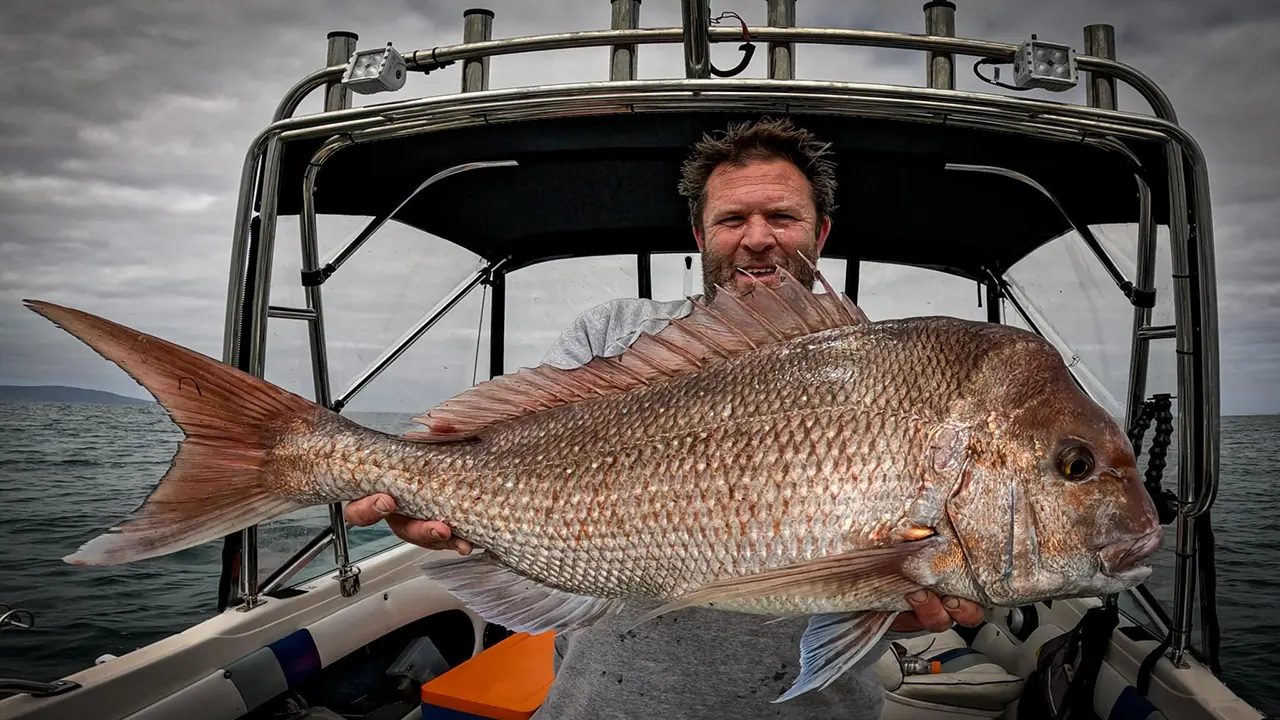
Early season reds from the north end of the bay. I practise what I preach — that’s where these came from.
When early season actually is
1 September through to about mid-October. That’s the window. After that it stops being early season and starts being the season proper, when the mass schools arrive and everyone catches them.
Why the north produces early — and why most people get it wrong
People reckon the fish bite up north earlier than they do off Mornington. That’s not it.
They’re all heading north. It’s built into them to move towards a freshwater source, so once they’re in the bay that’s the direction they go — and the top of the bay is where they end up. More fish up there, more people fishing up there, so more get caught up there.
Simple as that. It’s not a different bite, it’s a different number of fish.
They’re not sitting still
Early season fish are migrating and feeding hard. They’re getting fit to spawn, so they eat everything they can find, and they keep moving while they do it.
That matters more than anything else on this page. They don’t hold in one area for long early season. A spot that fired yesterday can be empty today — not because the fish shut down, but because they’ve moved on. Chase the pattern, not yesterday’s mark.
The zone moves every year
Here’s the part that trips people up. They don’t turn up in the same place two years running.
One year it’s straight onto Altona Reef. The next it’s up in the city. The year after that it’s off Werribee, or Brighton. Same bay, same time of year, different zone.
So don’t go hunting last year’s spot. Read where fish are actually getting caught right now — and once you see two or three come from the same general area, that’s your zone for the season. Then it builds. More fish, more often, in that same stretch.
And it’s worth paying attention early, because where the first fish come from is a good sign of where the numbers will be later. The early captures tell you where the school is stacking up before anyone else has worked it out.
How shallow they actually sit
Shallower than most people fish. That’s the single biggest reason blokes go home empty in September.
Plan your trip around the low light periods if you can. That’s when it happens.
Right in close. The darker it gets, the closer in they come.
The window where most of the fishing gets done.
I’ve caught them in 5 m at midday when it’s dead calm, but 7–10 is the better bet. Still not deep water.
The clue most people miss: land-based blokes catch them in the dark. Every year, all along the north end. That isn’t luck — it’s because the fish are in that shallow after dark.
Follow the land-based pages on Facebook and they’ll tell you which area is firing. If they’re getting them at Webb Dock, go and fish 3 m at Webb Dock in the dark. Just don’t park out the front of where they’re casting — fish nearby, not on top of them.
The reef-edge method
The easiest way I’ve found to target an early season snapper is a natural reef — but not anchored on top of it.
Find the edge and sit next to it. You keep your gear out of the snags, your baits sit on clean ground where the fish are feeding along the edge, and you can berley without feeding the reef itself.
Finding the reefs
I use side scan on the Lowrance and they come up easily enough. There are reefs the whole way from Ricketts Point up to near the city — not just the famous ones.
Black Rock is a great area, no doubt about it. The problem is there are a thousand and two boats sitting on it, all over the top of each other. You don’t need to be there. Go and find your own edge somewhere along that stretch and you’ll have it to yourself.
Thirty minutes and move
This is the part people get wrong. Because the fish are moving, you have to move too.
- Anchor beside the reef edge and get the berley going — pilchards out.
- Don’t sit down. Keep casting, keep rotating through the rods.
- Pinkies will maul you and steal the half pilchards. Rebait and keep going — that’s the job.
- Give it thirty minutes. If nothing’s happened, pull up and go to the next reef.
Half an hour sounds short. It isn’t. If there’s a fish there in early season, it’ll usually let you know inside that window. Sitting on a dead reef for three hours is how a good day gets wasted.
You are going to get snagged. Accept it.
I’m not going to paint this pretty. Six to ten snags in a six-hour session is normal, and probably more. Even fishing the edge. To be where the fish are, you’re going to get snagged — that’s just part of it.
Which leads to the thing most people won’t tell you.
Early season in the city, I don’t use leader
Not because leader’s wrong. Because you’ll go mad.
Tie a rig, snag it off, tie another leader, double uni, tie another leader, double uni. Four or five hours of that and you will physically give up and go home.
So up in the heavy reef early season I run Reedy’s 187 suicide hooks tied straight to 20 lb mono main line. No leader. Grab two packets of 187s and you can snag off all day without losing your mind. Suicide hooks early season, not circles.
You will lose the odd fish doing it this way. I’m not pretending otherwise. Shallow early season snapper are brutal — they run straight through the reef and they’ll cut you off. But a rig in the water beats a perfect rig you’re still tying when the bite window closes, and it’s not tackle theory, it’s time. There isn’t any.
Be a Harry high sticker
When you do hook up in the shallows, everything you’ve been told about rod angle goes out the window.
Hold the rod up high and keep their head up off the bottom. That’s the whole job. In two or three metres over reef, a snapper that gets its head down is gone — straight through the reef and cut off.
And don’t go hard on them. Normal drag, steady pressure. If you start locking drags up and carrying on like a maniac you’ll lose the fish. Keep the rod high, keep their head up, and they’ll come to you.
Nine times out of ten you’ll land every fish you hook, as long as you don’t freak out.
When to fish plastics — and when I don’t
Plastics catch snapper. No argument there. But early season I stick with bait, and it’s worth explaining why rather than just saying it.
It comes down to the hook. A jig head sits differently to a suicide hook, and over reef in shallow water early season I drop a lot more fish on one than the other. When you might only get one or two good bites in a session, dropping half of them hurts.
The other thing is I can’t see what the plastic gives me. An unweighted pilchard does the same job — it drifts down naturally, it looks alive, and it comes with a hook that holds. If you can get the same presentation with a better hook-up rate, that’s the one I’ll run.
Come the start of November it’s a different story. Water’s warmer, fish are settled, and plastics fished shallow will absolutely produce. That’s when I’d reach for them.
One fish isn’t the same as consistency
Let me be clear about what I’m actually saying, because someone will go out tomorrow, land one on a plastic, and tell me I’m wrong.
Of course it can be done. That was never the argument.
The question is whether you can do it consistently, season after season. I’ve been at this eighteen years, and I could count on one hand the blokes in Melbourne who genuinely produce early season fish on plastics year in, year out. It’s a short list.
So it comes down to what you’re actually out there for. Are you trying to catch fish, or trying to catch one a certain way? Both are fine — they’re just different goals, and they call for different gear. If it’s the first one, early season, leave the plastics home.
And one worth knowing: plenty of blokes putting up good numbers on plastics are tipping them with bait as well. It works — a bit of squid or pilchard on the tail of a plastic is a genuinely good trick. It just doesn’t always get mentioned when the photo goes up.
Catching pinkies on plastics isn’t the same test either. Pinkies will eat almost anything. Landing a proper red on reef in three metres is where the difference shows up.
Plenty of good anglers will disagree with me on all of this, and that’s fair enough — fish how you like to fish. This is what’s worked for me over a lot of early seasons.
Baits and berley
Squid, pilchards and sauries. That’s it early season.
Berley matters, but not the way people think. Use a berley pot and keep it contained — don’t throw loose berley over the side early season. The fish might not be feeding super hard yet, and the last thing you want is to fill them up on berley before they find your bait.
The other two things
Fresh soft baits and big tides. Get the tide right, be in the right depth, be on a reef edge, and an early season snapper isn’t that hard to catch. It’s when people fish too deep, too still and too long that it gets hard.
30 Oct – 7 Nov 2026 · Nine days
Fishing the top of the bay? You’re in the comp’s water.
The Two Bays Snapper Challenge runs across Port Phillip Bay and Western Port. Launch from Altona, Williamstown, St Kilda, Werribee or anywhere else — you fish your own patch, no travelling, no nominated zone.
First prize is a $22,499 Stacer and Mercury boat package, and more than $90,000 worth of prizes went out last year. New for 2026 you can fish it with your mates in the Team Challenge, or for your club in the Club Challenge.
Northern Port Phillip FAQs
When does the snapper season start in northern Port Phillip Bay?
Early season runs from about 1 September to mid-October. The north end of the bay fires before the rest of it — the fish head north towards freshwater once they’re in, so the top of the bay sees them first.
Do early season snapper turn up in the same place every year?
No. One year it’s Altona Reef, the next it’s up in the city, the year after it’s off Werribee or Brighton. There’ll always be a zone up the north end where it happens, it’s just a different suburb each season. Watch where fish are actually being caught rather than chasing last year’s spot — and where the early ones come from usually tells you where the numbers will be later.
How deep should I fish for early season snapper?
Shallower than you think. As little as 2.5 metres in the dark, and 2 to 7 metres around first and last light. The darker it is, the closer in they sit. Most people fish too deep in September.
Where do you fish in the north end of the bay?
Natural reef edges anywhere from Ricketts Point up towards the city. Black Rock holds fish but it’s crowded — there’s reef the whole way along that stretch, so find your own edge and you’ll have it to yourself.
Should I anchor on the reef?
No — anchor beside the edge of it. You stay out of the snags, your baits sit on clean ground where fish work along the edge, and your berley isn’t just feeding the reef.
How long should I stay on a spot early season?
About thirty minutes. Early season fish are migrating and don’t hold in one place, so if nothing happens in half an hour, move to the next reef. Keep casting and rotating rods the whole time rather than sitting down.
Do you use a leader for early season snapper?
Not in the heavy reef up in the city early season. You’ll get snagged six to ten times in a session, and re-tying leader and double unis all day will wear you out. I tie Reedy’s 187 suicide hooks straight to 20 lb mono main line and carry two packets so I can keep fishing.
How do you fight a snapper in shallow water over reef?
Rod up high and keep their head up off the bottom — go against the usual advice about high sticking. In two or three metres over reef, a fish that gets its head down runs straight through it and cuts you off. Don’t lock the drag up either. Normal drag, steady pressure, keep the head up and they’ll come to you.
Should I use soft plastics for early season snapper?
Early season I stick with bait. A jig head doesn’t hold a fish as well as a suicide hook over reef, so you drop more of them — and when you might only get one or two good bites in a session, that matters. An unweighted pilchard gives you the same natural presentation with a better hook-up rate. It’s not that it can’t be done on a plastic — it’s whether you can do it consistently year after year, and that’s a short list of blokes. From about the start of November, when the water’s warmer, plastics fished shallow will definitely produce.
What are the best baits for early season snapper?
Good baits rather than best — squid, pilchards and sauries. Use a berley pot and keep the berley contained rather than throwing it loose, because early season they may not be feeding hard and you don’t want to fill them up before they find your bait.
Why do land-based anglers catch them when boats don’t?
Because the fish come right in after dark and the boats are sitting out too deep. Watch where the land-based blokes are getting them and fish that same shallow water — just not directly in front of where they’re casting.
You’ll never hear me say “the best”
Read back through this page and you won’t find me calling anything the best hook, or the best bait. You’ll find a good hook and a good bait.
That’s on purpose. How would anyone measure it? Nobody’s down there with a scuba tank watching which hook the fish prefers. Everyone stating it as fact is doing the same thing I am — going off their own results.
Some of it comes down to how many hours you’ve had to form the view. But honestly, the longer I do this the less certain I get about anything. Anyone who’s gone deep on something they love probably knows that feeling.
So take everything here as one bloke’s experience, not gospel. There are people who fish these grounds differently to me and do very well — and I’d happily sit and listen to how they go about it.
Why I bother writing this down
Anyone can catch a snapper. Go out enough times and you’ll get one.
What’s hard is catching them consistently — this September, next September, and the one after that. Being the bloke who comes home with fish in the weeks when everyone else says it’s too early. That takes years, and it takes a way of going about it rather than a lucky spot.
I’ll be upfront about where this comes from, because I reckon you should know what you’re reading.
Think about how much you know about your own job. Not the general idea of it — the small stuff, the shortcuts, the things you’d never think to explain because they’re just obvious to you by now. That’s what turning up every day does.
That’s what I’ve done with snapper, near enough 365 days a year. The business is built around them, I run two snapper comps, and there isn’t a day where I’m not fishing for them, thinking about them or working on something to do with them. That’s not me being clever — it’s just a lot of hours pointed in one direction.
And the honest bit: I’d rather fish for them when it isn’t snapper season. During the run I’ll happily take mates out and catch a few. But I like it more when they’re hard, when you’ve got to work for one. That’s where you learn anything. Probably says something about me that I prefer it that way.
Which is the only reason I write any of this down. Not to tell anyone how they should fish — plenty of people do it their own way and do it well. Just in case some of it saves you a season or two of working it out the hard way, like I did.
Everything on this page is what I’ve landed on after eighteen years of that. It won’t be right every time. The fish will make a liar out of me regularly, and that’s fishing. But work through it, learn your own reefs, keep moving, and you’ll build something that keeps producing long after a hot spot has gone cold.
That’s what I’d want someone to take from it. Not one fish today — fishing well for the next twenty years.
Anyway. That’s how I go about it. Get out there and find your own reef.
More from Reedy’s Rigs
- Melbourne Snapper — when they arrive and where to fish month by month.
- Snapper Fishing Port Phillip & Westernport — rigs, baits, tides and both bays.
- Live Fishing Window — barometer and the biggest tides for both bays.
- Boat Fuel Calculator — what the run to your spot actually costs.
- The rigs I use — pre-tied snapper rigs, hooks and leader.
For daily reports, follow my Facebook page, and subscribe on YouTube.